
Teaching History with Immersive 360° Worlds: A Complete Guide
History is about places and people students will never meet. Immersive 360° worlds let them walk through the past instead of reading about it. Here's why it works, how to plan rigorous immersive history lessons, and ideas for every key stage.
Key Takeaways
- Immersive worlds turn abstract history into a place students can walk through.
- Seeing scale, layout and daily life builds historical empathy and understanding.
- Then-and-now comparisons anchor change over time to a real location.
- Reconstructions work for any period a world exists for, from Roman Britain onward.
- Pair exploration with source work and discussion to keep it rigorous history.
- Immersive history is inclusive — every student takes the trip, regardless of budget or mobility.
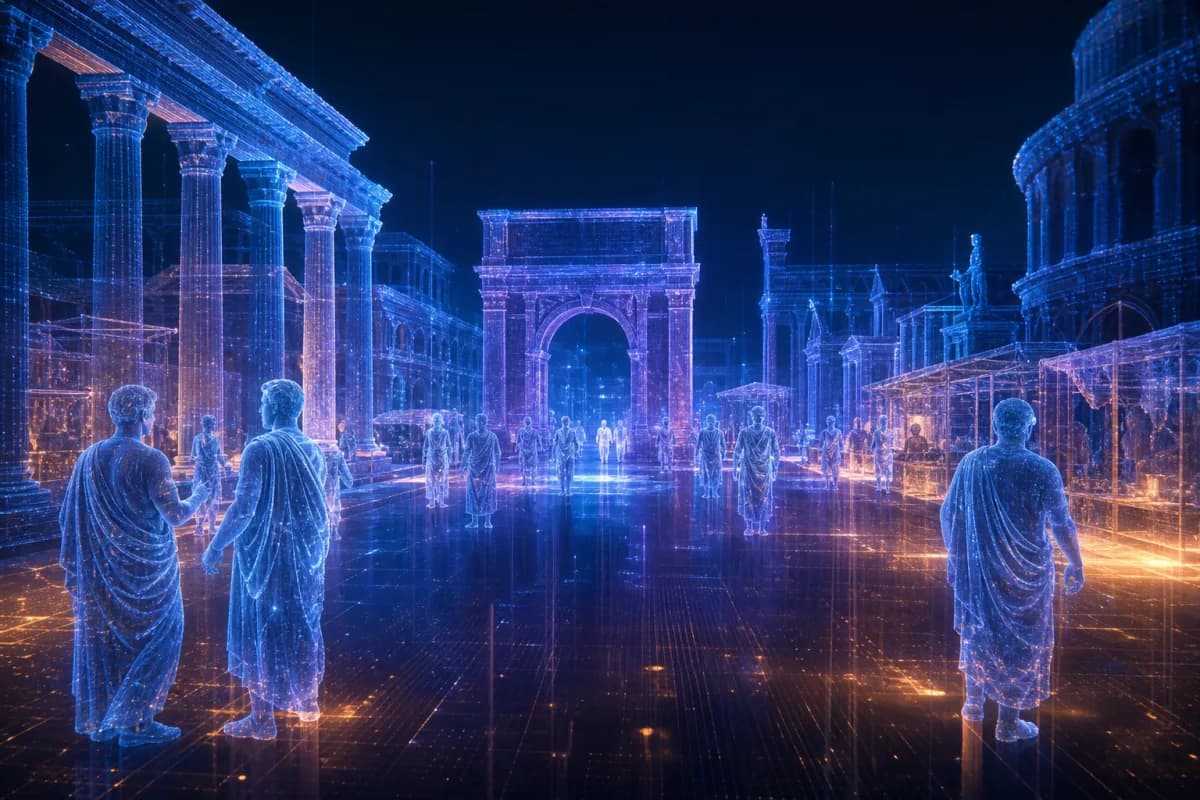
History asks students to care about people they'll never meet and places that no longer exist. Textbooks and timelines make that a stretch: a date is easy to copy down and just as easy to forget. Immersive 360° worlds close the gap. Instead of reading that Roman London had a forum, a bridge and a bustling waterfront, students stand in it and see the scale for themselves. Presence does for history what no amount of description can — it turns an abstract period into a place lodged in memory.
This guide explains why place matters so much in history, how to build immersive history lessons that stay rigorous, and gives you ready-to-use structures and ideas for every key stage.
Why place matters in history
So much of historical understanding is fundamentally spatial. How big was the town? How close together did people live? What did an ordinary person see on the walk to market? How far was it from the fort to the river? These questions are hard to answer from a list of facts and remarkably easy to answer by looking around.
This is the immersive learning principle applied to the past: anchoring events to a place students have explored makes them stick, because human memory evolved to remember places. Walk through Roman London once and the abstract idea of "Roman Britain" acquires a concrete, memorable setting — one that later facts, sources and narratives can attach themselves to.
There's a second reason place matters. History is not just a sequence of events; it's the study of change over time in real locations. A student who has stood in a reconstructed street can genuinely appreciate what it means for that street to change across centuries. Without the place, "change over time" is an abstract phrase; with it, it becomes something visible and felt.
From passive recall to active enquiry
The most important shift immersive worlds enable is from watching to exploring. A documentary shows students what a director chose to frame; a 360° world lets them look wherever curiosity takes them. That agency matters because history is an enquiry discipline: good historians ask questions, gather evidence and weigh interpretations. An explorable world is a natural engine for questions.
When a student notices that a Roman bridge sits exactly where it does, or that the streets follow a particular grid, they have generated a genuine historical question — one you can then investigate with sources. The world provides the spark; the evidence provides the answer. That combination keeps immersive history rigorous rather than merely atmospheric.
Four ways to teach history immersively
1. Build a sense of scale and layout
Before any narrative, let students simply explore a reconstructed place and describe what they notice: the size of buildings, the width of streets, the distance between key features, the materials, the crowds. Ask them to sketch a quick map or list five observations. This grounds everything that follows and gives every student — regardless of prior knowledge — something concrete to contribute.
Scale is especially powerful because it's so hard to convey in words. Telling a class that a Roman basilica was enormous means little; letting them stand beneath one communicates it instantly.
2. Develop historical empathy
Standing in a reconstructed street, students can imagine daily life far more readily than from a paragraph. Ask: who lived here? What was their day like? What can we see that they would have seen — and what would have been utterly alien to them? What did it smell like, sound like, feel like?
Historical empathy — the disciplined attempt to understand how people in the past saw their own world — is a core historical skill and a notoriously difficult one to teach abstractly. Immersion is a direct route to it, because it gives students a shared vantage point from which to imagine.
3. Compare "then and now"
The most powerful history move is change over time, and immersive worlds make it tangible. Explore a historic reconstruction, then look at the same location today. What survived? What vanished? What was built over, and why? Worlds like London Through Time let students compare Roman, medieval, Victorian and modern versions of the same city, turning "change over time" from a phrase into a visible, investigable phenomenon.
You can extend this into cause and consequence: why did the place change? What decisions, disasters, technologies or populations drove it? The visible contrast motivates the explanatory work.
4. Generate enquiry questions
Use exploration to raise questions, then investigate them with sources. "Why was the bridge built here?" "Why are the streets laid out this way?" "Who paid for this building?" The world sparks curiosity; source work answers it. This keeps the lesson firmly within the discipline of history, not just a sightseeing tour, and it models exactly how real historians work — from a puzzling observation to an evidenced explanation.
Keeping it honest: reconstructions vs the record
A reconstruction is an informed interpretation, not a photograph of the past — and saying so out loud is itself excellent history teaching. Rather than presenting a world as "how it was", present it as "our best current interpretation based on evidence", and interrogate it with students:
- What evidence is this reconstruction based on — archaeology, written sources, comparable sites?
- What did the makers have to infer or guess?
- Where might it be wrong, and how would we find out?
- What would change our picture if new evidence emerged?
This turns the world into a lesson about how we know history — the discipline of interpretation and evidence — not merely what happened. It's a habit of mind that transfers to every topic, and it inoculates students against the idea that any single depiction of the past is the whole truth.
A sample lesson shape
A reliable structure for an immersive history lesson runs in four phases:
- Explore (10 min): students walk the reconstruction and note observations, with no narrative yet — just noticing.
- Question (5 min): turn those observations into enquiry questions as a class, and pick one or two to pursue.
- Investigate (20 min): interrogate sources — written extracts, artefacts, maps, images — to answer the questions.
- Discuss (10 min): what did we learn, how confident are we, and what does the reconstruction get right or leave uncertain?
For the general planning framework this slots into, see how to plan a virtual field trip, which covers objectives, previewing and follow-up tasks in detail.
Lesson ideas by theme
- Roman Britain: explore Roman London, map the town, then investigate what daily life was like for different groups — soldiers, merchants, enslaved people, citizens.
- Change over time / local history: use London Through Time to track how one place transformed, then explain the causes of the biggest changes.
- Hidden histories: the hidden alleys and secret pubs of London surface the stories that formal narratives often skip, prompting questions about whose history gets told.
- Disaster and testimony: step aboard the Titanic to connect a vivid place with survivor testimony and the reliability of sources.
Immersive history is inclusive history
One of the quiet strengths of teaching history this way is inclusion. A physical trip to a historic site excludes some students by cost, distance or mobility. An immersive world brings the site to a calm, familiar classroom where every student takes the same trip together. For students with additional needs, the self-paced, controllable nature of exploration is often far more accessible than a busy heritage site — see immersive learning for SEND students.
Beyond the classroom walls
The same reconstructions that work on a projector also work in VR headsets for full presence, and on tablets for paired exploration. You don't need any of that to start, though — see do you need a VR headset? for the full picture. A whole-class walkthrough on the interactive whiteboard, with a strong enquiry question and good source work, is already powerful history teaching.
Bringing it into your curriculum
The real value of immersive history comes from making it routine rather than a one-off treat: a reconstruction to open a new period, a "then and now" comparison to teach change, a place to anchor a difficult source. Once you've run the four-phase structure once, planning the next lesson takes minutes.
Explore the full library of historical worlds to find one for your current topic, and to build immersive history into your curriculum across every year group see 360Worlds for schools, view pricing, or book a demo.
Frequently Asked Questions

The 360Worlds Team
Immersive Learning Specialists
We build immersive educational worlds that let learners explore history, science, geography, space and nature through interactive 360° experiences.
Related Articles
Immersive Learning for SEND Students: An Inclusive Guide
Immersive worlds can make learning more accessible, calming and inclusive for students with SEND — from removing the barriers of physical trips to offering a low-pressure, multisensory, self-paced way to explore. Here's why it works and how to do it well.
What Are Virtual Field Trips? A Complete Guide for Teachers, Parents and Schools
Virtual field trips let a class explore anywhere — the pyramids, a coral reef, Roman Londinium or the surface of the Moon — without leaving the room. Here's what they are, how they work, their benefits, and how to run one well.

Immersive Learning Explained: What It Is, Why It Works and How It's Transforming Education
Immersive learning places students inside realistic digital environments — through VR, 360° worlds and interactive simulations — so they explore and discover rather than passively read. Here's what it is, why it works, and how to use it in any classroom.