
Immersive Learning for SEND Students: An Inclusive Guide
Immersive worlds can make learning more accessible, calming and inclusive for students with SEND — from removing the barriers of physical trips to offering a low-pressure, multisensory, self-paced way to explore. Here's why it works and how to do it well.
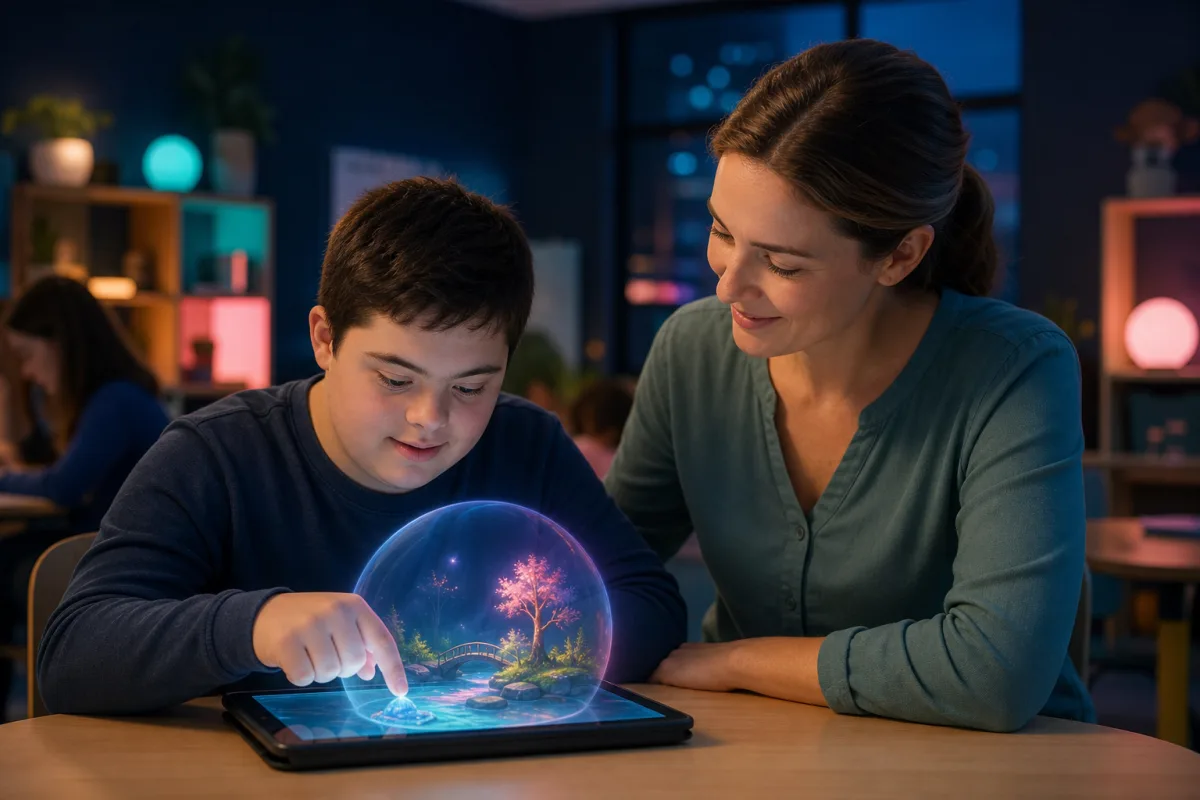
Key Takeaways
- Immersive worlds let SEND students join experiences that physical trips exclude them from.
- Exploration is self-paced and repeatable, reducing pressure and anxiety.
- The familiar classroom setting avoids the sensory overload of new environments.
- Multisensory, visual learning suits many different needs and learning styles.
- Teacher control over pace, content and delivery makes lessons easy to adapt.
- Screen-based delivery is often more inclusive than headsets — offer headsets only where welcome.
Physical field trips exclude some students by design. The travel, the cost, the unfamiliar venue, the crowds and the noise, the physical access requirements — for many learners with special educational needs and disabilities (SEND), a coach trip to a busy site is a barrier, not an opportunity. Too often the answer has been separate provision, or simply missing out. Immersive learning changes that equation entirely: it brings the destination to a calm, familiar, controllable classroom where everyone can take part on equal terms.
This guide explains why immersive learning is naturally inclusive, how it helps across a range of needs, and how to run immersive lessons that include every student.
Why immersive learning is naturally inclusive
The same features that make immersive learning effective in general turn out to be especially valuable for SEND — not as an afterthought, but as a core strength:
- It removes physical barriers. No travel, no inaccessible venues, no cost — a virtual field trip to the deep ocean or ancient Rome happens from the students' own classroom, with no need to navigate a building designed for someone else's body.
- It's controllable. Pace, volume, content and duration are all in the teacher's hands, so the experience can be tuned to the class and to the individual, moment by moment.
- It's repeatable. Students can revisit a scene as many times as they need, without pressure, embarrassment or a ticking clock. Repetition that would be impossible on a real trip is trivial in a virtual one.
- It's multisensory and visual. Rich visual exploration suits many learners who find text-heavy or purely verbal instruction difficult, offering an alternative route into the same content.
- It's predictable. Unlike a real venue, a virtual world holds no surprises — you can preview exactly what students will encounter and prepare them for it.
Practical benefits for different needs
Every student is an individual, and the notes below are starting points rather than rules — but they illustrate how flexible immersive learning can be.
Anxiety and low confidence
New environments and social pressure can make physical trips genuinely stressful, sometimes to the point that a student can't attend at all. An immersive world explored from a familiar room removes the unpredictability while keeping the experience. Students can step back, look away or pause at any moment, which gives them a sense of control that lowers anxiety and builds confidence to engage.
Sensory sensitivities
Real venues are unpredictable by nature — sudden noise, crowds, bright or flickering lights, unfamiliar smells. A projected or tablet-based world is far more controllable: you can adjust or mute the volume, choose calmer scenes, and keep the room familiar and low-stimulus. For many students with sensory sensitivities this is more inclusive than a headset, which can feel enclosing or overwhelming, so offer headsets only where genuinely welcome.
Mobility and medical needs
Students who physically can't join a coach trip take part fully in a virtual one — the same destination, the same lesson, alongside their peers, with no separate provision and no sense of being left behind. A learner in hospital or at home can join the same reef or the same Roman street as the rest of the class.
Attention and engagement
The presence and agency of immersive exploration can capture attention that worksheets and slides lose. For students who find sustained attention difficult, a self-directed, visually rich environment offers a positive, active way into a topic — and the ability to choose where to look gives them ownership of the experience.
Communication and language needs
A shared immersive experience gives every student concrete, common ground to talk and write about. Rather than starting from abstract prompts, students can describe something they've all just explored, which supports vocabulary development and gives less confident communicators an accessible starting point.
Tips for inclusive immersive lessons
- Prefer the projector or tablet first. It's the most inclusive default; introduce headsets only where a student is comfortable and it clearly adds value.
- Introduce gradually. Preview what will happen so there are no surprises, and let anxious students see the world before the lesson if that helps.
- Control the sensory load. Manage volume, choose calmer scenes, keep sessions short, and pause whenever needed.
- Offer choice and control. Let students decide where to look and when to move on — agency reduces pressure and increases engagement.
- Provide a clear way out. Make it explicit that students can step back, look away or opt out at any time, with no fuss.
- Follow up flexibly. Offer varied ways to respond — drawing, talking, pointing, writing — so every student can show what they explored in the way that suits them.
- Plan for the individual. Use what you know from EHCPs and support plans to anticipate triggers and adapt pace, content and delivery in advance.
For the general lesson framework these tips slot into, see how to plan a virtual field trip.
Immersive learning across the SEND curriculum
Inclusive immersive lessons aren't limited to one subject. A historical reconstruction gives a concrete sense of place; a journey through the human body makes abstract science tangible; a calming natural scene supports wellbeing and regulation. The common thread is that a shared, controllable, visual experience meets a wide range of needs at once.
Inclusion is the point
The strongest argument for immersive learning in a SEND context is simple: it lets students who are routinely left out of trips and experiences take part on equal terms. The reef, the Roman street, the surface of Mars — all reachable from a calm, familiar classroom, for every learner, together. That's not a consolation prize for students who can't attend the "real" thing; for many, it's a better, more accessible experience in its own right.
To bring accessible, inclusive immersive learning to your school across every subject, explore 360Worlds for schools, view pricing, or book a demo and we'll help you plan an inclusive rollout.
Frequently Asked Questions

The 360Worlds Team
Immersive Learning Specialists
We build immersive educational worlds that let learners explore history, science, geography, space and nature through interactive 360° experiences.
Related Articles
Teaching History with Immersive 360° Worlds: A Complete Guide
History is about places and people students will never meet. Immersive 360° worlds let them walk through the past instead of reading about it. Here's why it works, how to plan rigorous immersive history lessons, and ideas for every key stage.
What Are Virtual Field Trips? A Complete Guide for Teachers, Parents and Schools
Virtual field trips let a class explore anywhere — the pyramids, a coral reef, Roman Londinium or the surface of the Moon — without leaving the room. Here's what they are, how they work, their benefits, and how to run one well.

Immersive Learning Explained: What It Is, Why It Works and How It's Transforming Education
Immersive learning places students inside realistic digital environments — through VR, 360° worlds and interactive simulations — so they explore and discover rather than passively read. Here's what it is, why it works, and how to use it in any classroom.